

Most marketing strategies focus on tactics: run this ad, write this blog post, post on social media, send this email. Tactics matter. But without a clear picture of how your customer actually moves from first discovering you to becoming a loyal buyer, you are applying those tactics in the dark.
Customer journey mapping changes that.
Quick definition: A customer journey map is a visual or written representation of every step a customer takes from the moment they first become aware of your business to their experience after purchase. It helps you identify where your marketing is working, where it is failing, and where opportunities are being missed.
Why Journey Mapping Matters for Marketing
Without understanding your customer’s journey, you can’t know:
- Why people visit your website but don’t contact you
- Where in the sales process you’re losing leads
- What questions prospects have before they feel ready to buy
- What would make a past customer come back
Journey mapping gives you a framework to answer all of these — and to prioritize where your marketing energy and budget should go.
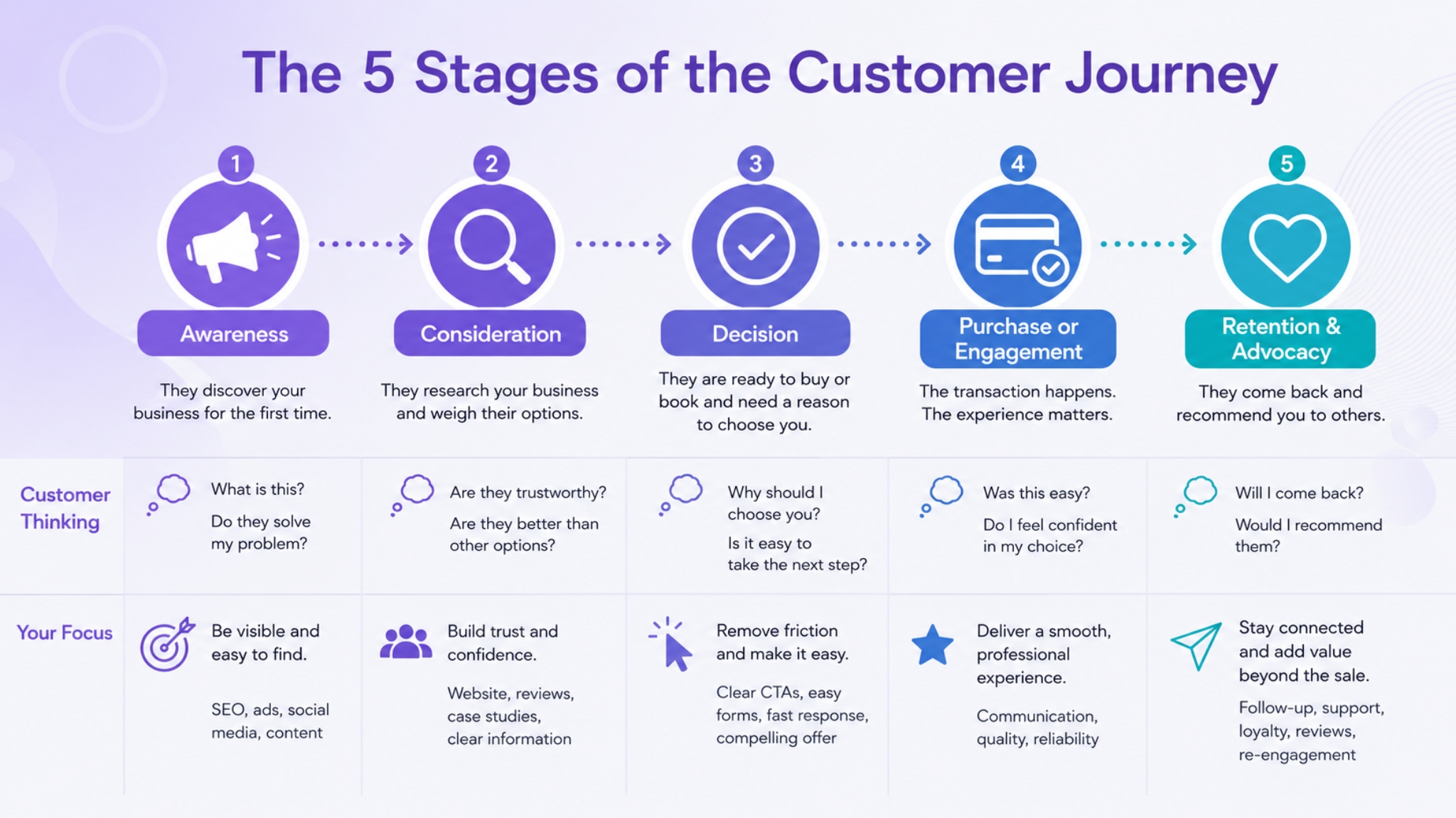
The Five Stages of the Customer Journey
Stage 1: Awareness.
This is when a potential customer first learns your business exists. Maybe they saw your Google Ad. Maybe a friend mentioned you. Maybe they searched for a service you offer and found your website.
The marketing question here is: how easy is it for your ideal customer to find you? This is where SEO, paid ads, and social media presence matter most.
Stage 2: Consideration.
Now the prospect is actively evaluating you, often alongside competitors. They’re reading your website, checking your Google reviews, looking at your social media, or comparing prices.
The marketing question: does what they find build confidence or create doubt? Website quality, review volume, clear service descriptions, and case studies all influence this stage.
Stage 3: Decision.
The prospect is ready to buy or book — they just need to take the last step. This is where friction matters most.
Is your contact form easy to find? Does your phone number work? Is booking an appointment straightforward? Is there a clear, compelling reason to choose you over the competitor they’re also considering?
Stage 4: Purchase or Engagement.
The transaction happens. But the journey isn’t over — this is actually one of the most important moments for long-term loyalty.
How does the customer feel during and immediately after the transaction? Smooth, professional, communicative experiences here create the foundation for repeat business and referrals.
Stage 5: Retention and Advocacy.
The customer has bought. Now the question is: will they come back? Will they tell others?
This is driven by follow-up communication, the ongoing relationship, and whether the customer feels remembered and valued beyond the transaction.
How to Build a Simple Journey Map
You don’t need expensive software or a full-day workshop. Start with a piece of paper or a simple spreadsheet.
- List the five stages above as columns
- For each stage, write down what your customer is thinking, feeling, and doing
- Then write down what touchpoints your business currently has at each stage — your ads, your website, your follow-up emails, your review requests
- Identify the gaps: stages where you have no touchpoint, or where your current touchpoint isn’t working well
The gaps are your priorities.
What Journey Mapping Usually Reveals
In our experience, most businesses have reasonable Awareness and some presence in Consideration — they’re getting found and they have a website. The gaps almost always show up in Decision (no clear CTA, confusing navigation, slow response times) and Retention (no follow-up, no re-engagement, no loyalty program).
Fixing those two stages is often where the fastest revenue gains come from — and it rarely requires more ad spend. It requires better systems.
If you want help mapping your customer journey and building the marketing systems to support each stage, Loop Marketing works with businesses to build strategies that account for the full picture.