

Understanding what customers want to know is one of the most important parts of an effective marketing strategy. Every day, potential customers search for answers, compare products, read reviews, and research businesses before making purchasing decisions.
But traditional keyword research does not always reveal the full picture.
AI-powered customer research helps businesses identify the questions, concerns, and information needs behind customer searches. By analyzing search data, customer feedback, online discussions, and other sources, AI can help marketers develop content that responds to real customer needs.
According to Butterly’s 2026 Canadian Consumer Survey, 82.3% of surveyed Canadian consumers research most or all purchases before committing. The survey included 3,522 respondents.
For businesses, this reinforces the importance of providing useful information throughout the customer journey, not just when someone is ready to buy.
Why Understanding Customer Questions Matters
Customers rarely begin their research knowing exactly which product or service they need.
A homeowner might search for signs of foundation damage before looking for a repair company. Someone experiencing hearing difficulties might research symptoms before considering a hearing assessment.
These early questions are valuable because they reveal the problems customers are trying to solve.
Businesses that answer these questions can establish credibility, introduce their services, and build relationships with potential customers before a purchasing decision is made.
However, many content strategies focus primarily on keywords with high search volumes. This can overlook specific questions that indicate genuine customer interest or purchasing intent.
AI-powered research can help uncover these opportunities.
How AI Helps Businesses Discover Customer Questions
AI research tools can analyze large amounts of information to identify patterns in how customers describe their problems and search for solutions.
Rather than looking exclusively at individual keywords, marketers can use AI to group related questions, identify recurring concerns, and understand the context behind customer searches.
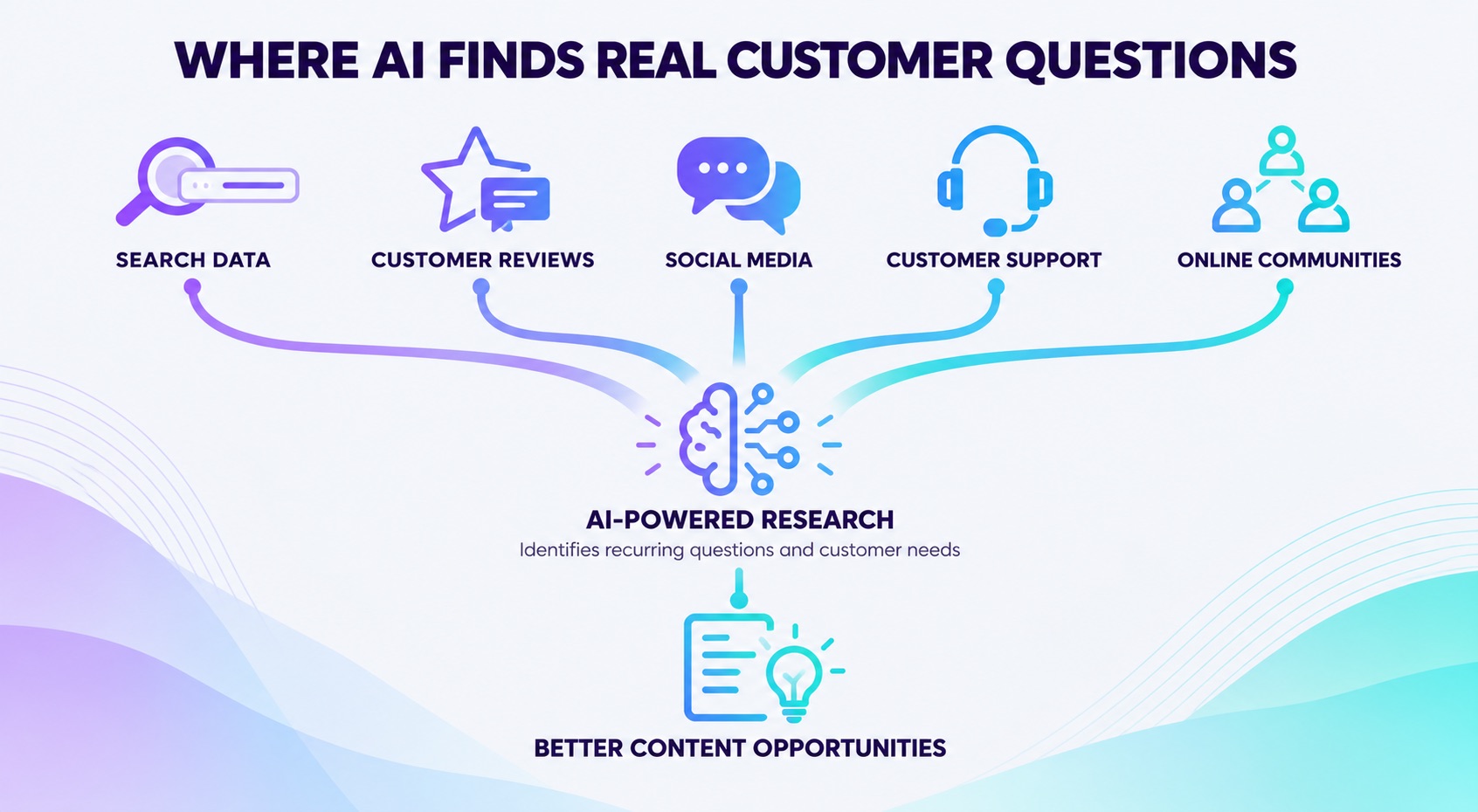
Useful sources include:
- Search engine data: Google Search Console, keyword research tools, and related search queries.
- Customer reviews: Recurring compliments, complaints, and questions about products or services.
- Social media conversations: Public discussions about common problems, expectations, and purchasing decisions.
- Customer service records: Questions received through emails, support tickets, and sales conversations, where their use is authorized.
- Online communities: Relevant discussions on forums and industry-specific platforms.
AI can help organize this information into themes that are easier to understand and act upon.
Importantly, AI-generated questions are not automatically evidence of customer demand. Businesses should validate findings against actual customer conversations, search data, and other reliable sources.
Finding Questions Traditional Keyword Research Might Miss
Traditional keyword research remains an essential part of SEO. It helps businesses understand search demand, competition, and the language customers use.
However, customers do not always describe their needs using short, predictable keywords.
Consider a business offering basement waterproofing services.
A conventional keyword strategy might focus on terms such as “basement waterproofing” or “foundation repair.”
AI-assisted research might uncover more specific questions:
- Why does my basement smell damp after heavy rain?
- Can water enter a basement without visible cracks?
- How do I know if my foundation needs waterproofing?
- Is basement moisture a problem when selling a house?
These questions reveal different concerns and stages of the customer journey.
Someone investigating a damp smell may need educational information, while a homeowner preparing to sell may be closer to requesting a professional inspection.
Understanding these distinctions helps businesses create content that serves customers at the right time.
Turning Customer Questions Into a Content Strategy
Discovering customer questions is only the first step. The real value comes from organizing those questions into a practical content plan.
Group Questions by Search Intent
AI can help categorize customer questions according to what someone is trying to accomplish.
Informational searches generally focus on understanding a problem. Commercial searches involve comparing options, evaluating providers, or determining costs. Transactional searches suggest someone is ready to take action.
These categories help businesses decide whether a question belongs in a blog article, FAQ, service page, or landing page.
Identify Gaps in Existing Website Content
Businesses often already have useful information on their websites, but it may not address the specific questions customers ask.
AI can help compare a list of verified customer questions against existing website content to identify missing answers, outdated information, and opportunities to improve clarity.
For example, a service page might explain what a company offers without addressing pricing, timelines, eligibility, or what customers should expect.
Adding these details can improve the experience for visitors while making the page more useful.
Prioritize Questions That Support Business Goals
Not every customer question needs its own article.
Some questions can be answered in a short FAQ, while others deserve a detailed guide or a dedicated service page.
Businesses should prioritize questions based on relevance, customer demand, search intent, and their connection to available services.
This prevents content strategies from becoming large collections of loosely related articles that generate traffic without supporting meaningful business outcomes.
Using Customer Research to Improve SEO and GEO
Understanding customer questions is increasingly important as people use both traditional search engines and AI-powered search tools to find information.
Search engine optimization (SEO) helps businesses make their content accessible, relevant, and understandable to search engines.
Generative engine optimization (GEO) focuses on making information clear, credible, and useful for AI-powered discovery and citation.
Both approaches benefit from content that directly addresses customer questions.
For example, an article answering a common customer concern should provide a clear response near the beginning, followed by useful explanations, examples, and supporting evidence.
Descriptive headings, accurate information, and logical content organization make it easier for readers to find answers. They can also help search and AI systems interpret the material.
However, publishing answers does not guarantee rankings, AI citations, or recommendations. Content quality, relevance, technical accessibility, and other factors still matter.
Why Human Expertise Still Matters
AI can identify patterns, organize research, and suggest content opportunities, but it does not always understand the full context of a business or its customers.
A question that appears frequently online may be irrelevant to your services. An AI-generated recommendation might misinterpret customer intent or overlook important industry requirements.
Human review is particularly important in industries where accuracy, trust, and professional expertise influence purchasing decisions.
The strongest approach combines AI-assisted analysis with real customer feedback, industry knowledge, and a clear understanding of business objectives.
AI can accelerate research. Experienced marketers determine which findings are worth acting on.
Build Better Content by Understanding Your Customers
Effective content marketing begins with understanding the people you want to reach.
AI-powered research makes it easier to discover customer questions, identify gaps in existing content, and organize information around genuine customer needs.
When combined with keyword research, SEO, GEO, and a well-defined marketing strategy, these insights can help businesses create more useful content and attract more relevant audiences.
At Loop Strategic Marketing, we help businesses connect customer research with content development, search visibility, and measurable marketing objectives.
Want to create content that answers the questions your customers are actually asking? Contact Loop Strategic Marketing to build a content strategy grounded in customer needs and business goals.