

Something significant has shifted in how people find businesses online.
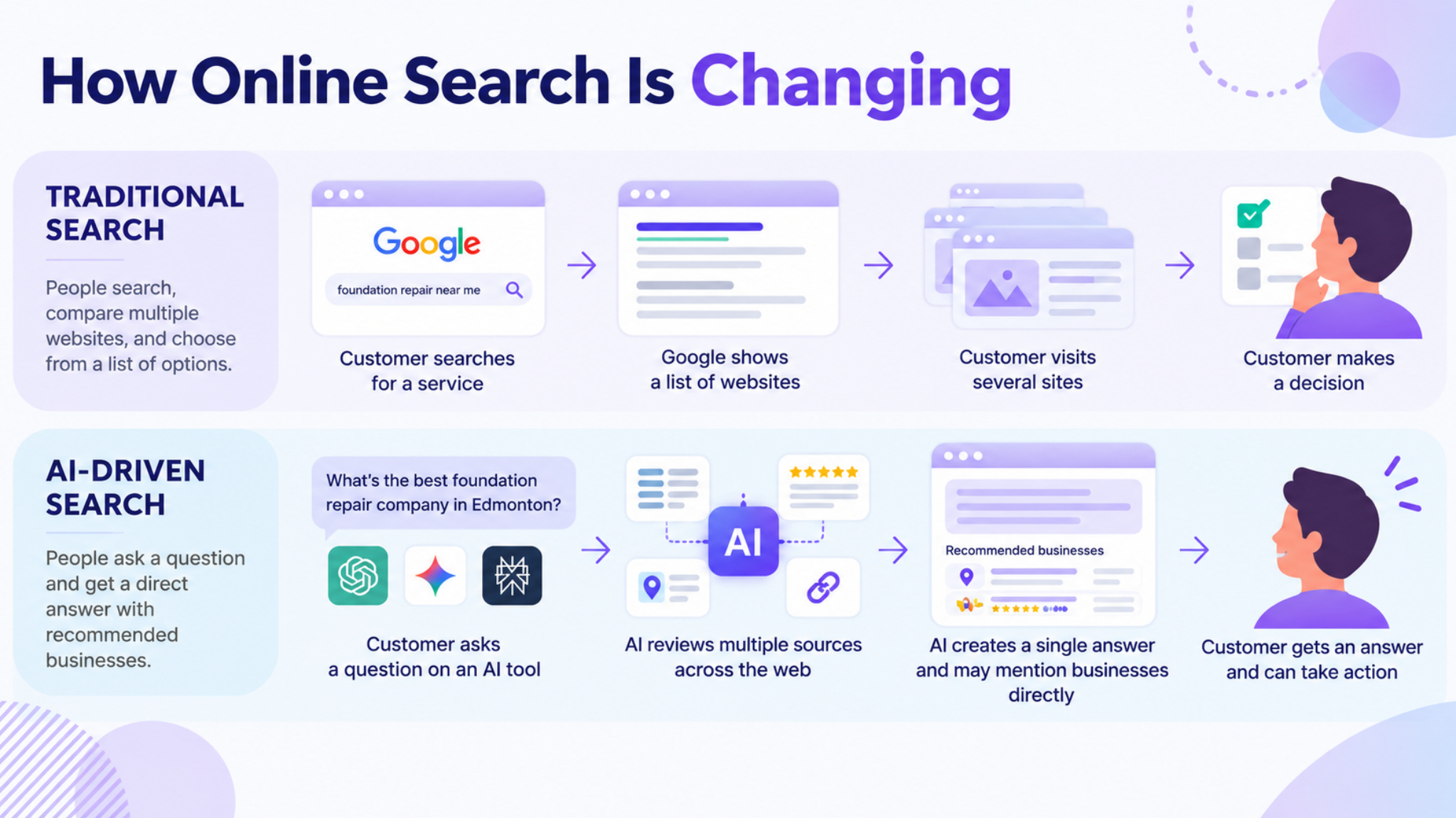
More and more, when someone asks a question on Google, they don’t get a list of ten blue links. They get an AI-generated answer at the top of the page that synthesizes information from multiple sources and delivers it in plain language. On other platforms — ChatGPT, Gemini, Perplexity — people are skipping search engines entirely and asking AI assistants directly.
The question for your business is no longer just ‘can Google find me.’ It’s ‘does AI know I exist, and does it recommend me?’
How AI Search Works (Plain Language Version)
AI search tools pull information from the web, review sites, structured data, and authoritative sources to construct answers. They are not pulling from a random selection of websites — they are pulling from sources they have determined are trustworthy, clearly written, and relevant to the question being asked.
To get mentioned, you need to be the kind of source these systems trust.
The Signals That Influence AI Recommendations
- Volume and quality of online reviews.
This is one of the most direct influence points. AI tools — especially those integrated with local search, like Google’s AI Overviews — draw heavily on Google Business Profile data and reviews. A business with 80 detailed, recent five-star reviews is far more likely to be surfaced than a competitor with 12 reviews from three years ago.
- Consistent and accurate business information across the web.
What is NAP consistency? NAP stands for Name, Address, Phone number. Having the same NAP information on your website, Google Business Profile, social media, and any directory listings tells search and AI systems that your business information is reliable.
Inconsistent information — your address listed differently on different sites, a phone number that changed six months ago but wasn’t updated everywhere — creates confusion for AI systems and reduces your chances of being cited.
- Clear, well-structured website content.
AI systems read web pages. If your website is well-organized, written in plain language, and clearly answers questions your customers are likely to ask, it becomes a source worth citing.
Pages that use headers to break up content, answer specific questions directly, and are written for humans rather than stuffed with keywords perform far better in AI-driven search.
- FAQ and question-based content.
AI tools are answering questions. If your website directly answers the questions your customers are asking — ‘How much does a foundation repair cost?’ ‘What should I look for in a hearing clinic?’ — you are positioning yourself as a relevant source for those AI responses.
- Schema markup.
What is schema markup? Schema markup is a small piece of code added to your website that helps search engines and AI systems understand what your content is about — your business name, location, type of service, reviews, and so on. It’s invisible to visitors but very visible to AI.
- Authority signals from third-party sources.
When other websites link to yours, when you’re mentioned in industry publications, when your Google Business Profile is complete and active — all of these tell AI systems that your business is an established, credible entity worth surfacing.
Practical Steps to Start Today
- Audit your Google Business Profile. Make sure it’s fully completed, your information is current, and you’re actively requesting and responding to reviews.
- Check NAP consistency. Search your business name and verify that your address and phone number are the same everywhere they appear.
- Add a FAQ section to your website. Write answers to the five most common questions your customers ask before buying from you.
- Ask satisfied customers for Google reviews. The volume and recency of reviews is one of the highest-impact signals you can influence directly.
- Have your website reviewed for schema markup. This is a technical task your web developer or marketing agency can handle.
Loop’s SEO team helps businesses optimize for both traditional and AI-driven search — building the kind of digital presence that gets recommended.