

An email list is one of the most valuable assets your business can own. Unlike social media followers — where a platform can change its algorithm overnight and cut your reach — your email list is yours. No middleman. No pay-to-play. Direct access to people who asked to hear from you.
The challenge is that most businesses either don’t have a strategy for building their list or use tactics that attract the wrong people. This article walks you through how to build a list that is relevant, engaged, and genuinely growing.
Start With the Right Mindset
A lot of businesses focus on list size. What actually matters is list quality.
A list of 500 people who are actively interested in your services will outperform a list of 5,000 who signed up for a random giveaway and have no real connection to what you do. Vanity metrics — numbers that look impressive but don’t drive business — are a trap.
Quick definition: A vanity metric is a number that looks good on paper but doesn’t directly translate to business results. Follower counts and raw email list size are common vanity metrics when not paired with engagement and conversion data.
Build slowly and build with intent.
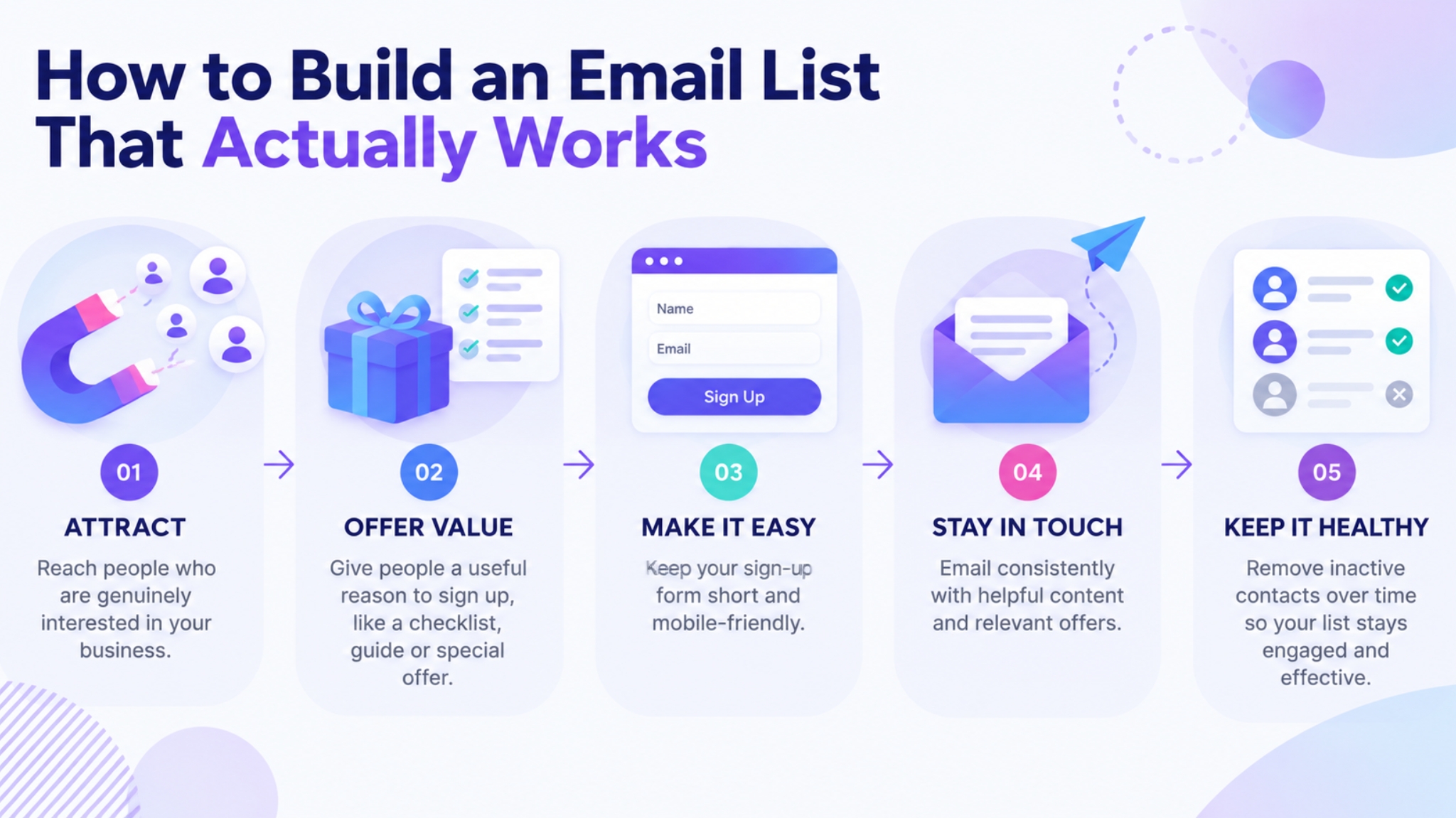
Where Your Sign-Ups Should Come From
Your website.
This is the obvious one, but most websites do it poorly. A footer subscription box that says ‘Sign up for our newsletter’ is one of the lowest-converting opt-in methods in existence. Nobody wakes up wanting more newsletters.
Instead, offer something specific in exchange for the sign-up. This is called a lead magnet — a free, valuable piece of content or a perk that is worth handing over an email address for.
Lead magnet examples: A free checklist, a short guide, a discount code, a free assessment, a helpful template, or access to a video. The best lead magnets solve a specific problem your ideal customer has right now.
After a purchase or service interaction.
The moment right after a transaction is one of the highest-trust points in your relationship with a customer. Ask them to join your list with a clear reason: ‘Sign up to receive maintenance tips and exclusive offers.’ Many will say yes.
Through your Google Business Profile and social media.
Your Google Business Profile posts and social media bios can include links to a sign-up page. These are warm audiences who are already paying attention to your business.
At events or in person.
If your business has any in-person touchpoints — trade shows, community events, at your physical location — collect emails there too. A simple tablet or paper sign-up sheet with a clear benefit statement works well.
What Not to Do
- Never buy an email list. People who didn’t ask to hear from you will mark your emails as spam, which damages your sender reputation and reduces deliverability for everyone on your list — including the people who genuinely want to hear from you.
- Don’t add people to your list without their consent. This is not just a best practice — in Canada, it is the law under CASL (Canada’s Anti-Spam Legislation).
- Don’t use the same sign-up incentive forever. Refresh your lead magnet once or twice a year to keep it relevant and appealing.
Make the Sign-Up Process Frictionless
Every extra step or field you add to a sign-up form reduces the number of people who complete it. For most businesses, name and email is enough. Maybe a phone number if follow-up calls are part of your process.
Test your sign-up form on a mobile device. If it’s hard to complete on a phone, fix it.
Keep the List Healthy
A list that never gets emailed goes cold. People forget who you are, and when you eventually do send something, your open rates suffer and your spam complaints go up.
Commit to a minimum cadence — even once a month — to keep the relationship warm. And periodically clean your list by removing contacts who haven’t opened your emails in six to twelve months. A smaller, engaged list will always outperform a large, disengaged one.
Not sure how to set up your sign-up forms, lead magnets, or email platform? Loop Marketing helps businesses build email systems that run on autopilot.